
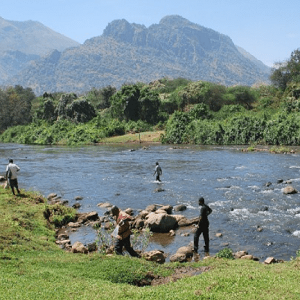
Building a Grassroots Constituency to Conserve the River Moyar in the Mysore-Nilgiri Corridor
Social Assessment to ensure compliance to CEPF Policy on Indigenous People
We proposed the project titled ‘Building a Grassroots Constituency to Conserve the River Moyar in the Mysore-Nilgiri Corridor on the premise that conservation programmes in the region have until date largely been perfunctory. We also found it ideal to propose a programme that takes a landscape approach rather be constrained by a politically or administratively defined unit, to ensure that the coverage is vast and uniform. The third and the most important factor that motivated us to propose this project is the fact that conservation research or programmes in the proposed project area have hitherto been very scarce in studying or involving human communities. It needs to be mentioned though that there have been a number of anthropological inquiries on the indigenous communities of the Nilgiris, largely during the Colonial period.
The proposed project design which takes the course of River Moyar as the deciding factor, covers at least five panchayats (decentralized grass root level planning and administrative units). This coverage though is not uniform. While the three panchayats viz Masinagudi, Mudumalai and Sholur would be most critical, the other two cover the fringe areas.
In-depth demographic studies of the three panchayats have not been carried out in the past; our preliminary assessment suggests that the landscape is home to the following broad categories of humans viz.
- Early settlers – largely during Pre-Colonial period who are now under the scheduled caste category of backward and most backward residing as homogenous units
- Recent settlers – mostly migrants in search of livelihoods
- Recent settlers – tribal communities – mostly communities in search of livelihood opportunities, landless labour and communities displaced from adjacent districts.
- Scheduled Tribes / Indigenous tribal communities – the original residents of the landscape, a number of endogamous groups. Notable for their involvement in the protection of the landscape. View themselves as custodians of the forest. Strong presence of customary rights and regulation in the use of natural resources. Notable are the Kurumbas (and their four sub-groups) and Irulars. Scheduled Tribes.
- The Scheduled Caste communities – considered the lowest in caste hierarchy. Not recognized by any past intervention in the landscape.
In view of the above, and also the past experience of working in other landscapes we propose the following:
The key outcome of the proposed project is the micro-plan, taking into consideration the following aspects:
- the project will not propose or create new jobs or provide dole in any form
- the project will recognize traditional and local institutions where indigenous and tribal communities are represented
- the project will ensure that no community is excluded because of their caste or tribal identity
- the project will ensure that marginal groups within the communities such as women are represented strongly.
- the project will attempt to understand and incorporate local cultural beliefs and norms for micro planning and will not seek to alter the same.
The project will be implemented only after consultations are held at the field level. These will be facilitated by the Gram sabha (an entity that is strictly voluntary and representative of all the communities) and the elected panchayat.
The proceedings of these consultations will be developed into mutual agreements.
The project will be jointly implemented with the Gram sabha and the panchayat. And as detailed in the proposal, it will be subjected to local review.
The Gram Sabha and the elected Panchayat for each community where the project will be implemented will function as a grievance mechanism for Indigenous People or other local communities who have any concerns or grievances about the project to raise them with the project team. In the unlikely event that a grievance is raised, Arulagam will ask the relevant Gram Sabha or Panchayat to convene a meeting between the project team and the affected parties, in order to resolve the conflict.
Arulagam will seek to hold these meetings within one month of any grievance being communicated to them. Any grievance raised will be communicated to CEPF, together with minutes from the meeting held to address them, plus a detailed plan of remedial action.
Long term sustainability of the project will be ensured will the project team working closely with the Gram Sabha and the Panchayat to develop proposals for the consideration of the State and Central Government, Other Non governmental organizations and Donor Agencies.
As a collaborative group of institutions striving to reconcile conservation and development goals, we appreciated the safeguards policy of CEPF and shall strive to adhere to all the issues/concerns and terms listed in the policy document.
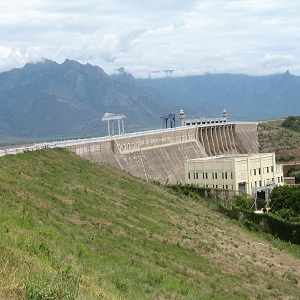
Annotated List of Fishes Identified from the Bhavani-Moyar and Bhavani Sagar Riparian Ecosystem
S.No. |
Name of the Species |
Source of Information |
|||||
|---|---|---|---|---|---|---|---|
| Mukherji | Srinivasan & Ganesan | Rajan | Menon | Yazdani et al | CEPF Project | ||
| 1 | Amblypharyngodon melettinus | + | |||||
| 2 | Anguilla bengalensis* | + | + | + | |||
| 3 | Aorichthys aor | + | |||||
| 4 | Aorichthys seenghala | + | + | ||||
| 5 | Barbodes bovanicus | + | + | ||||
| 6 | Barbodes carnaticus | + | + | + | + | + | + |
| 7 | Barbodes jerdoni | + | + | + | |||
| 8 | Barbodes sarana | + | + | + | + | ||
| 9 | Barilius bendelisis | + | + | + | |||
| 10 | Barilius gatensis | + | + | + | + | + | |
| 11 | Catla catla | + | + | ||||
| 12 | Channa gachua | + | + | + | + | ||
| 13 | Channa marulius* | + | + | ||||
| 14 | Channa punctatus | + | + | ||||
| 15 | Channa striatus | + | |||||
Annotated List of Fishes Identified from the Bhavani-Moyar and Bhavani Sagar Riparian
Mukherji D D (1937) On a small collection of fish from the Bhavani river (S. India) BNHS35: 162-171 R Srinivasan and R Ganesan (1955) Contributions from the freshwater biological research station Bhavanisagar, Madras State No 1 Rajan, S (1955). Notes on a collection of fish from the headwaters of Bhavani river, south India. JBNHS 53: 44-48& Rajan, S (1963) Ecology of the fishes of rivers Pykara and Moyar (Nilgiris), S. India. Proc. Ind. Acad. Sci. 58 (B): 291-323 Menon, A G K (1999) Checklist –Freshwater Fishes of India, ZSI/Occasional Paper No 175 Yazdani, G M, Rema Devi, K, Raghunathan, M B and Singh, F D (2001) Fauna of Conservation Areas, Series 11: Fauna of Nilgiri Biosphere Reserve. Zoological Survey of India, pp207-224; this list is based on published information and 25 surveys in and around the Nilgiri Biosphere Reserve; only those specifically mentioned as Bhavani and/or Moyar Rivers are included. CEPF- Team: R J Ranjit Daniels, C Chenna Krishnan, N Muthu Karthick, K Ramasamy (Tracker), L Selvam (Fisherman), Kumar (Driver-cum-fisherman), Mahesh (Forest Guard), Das (Forest Watcher); Fish reported/seen during the field trip to Bhavani Sagar and Moyar River in February (8-11) 2011 and April (10-11) 2011
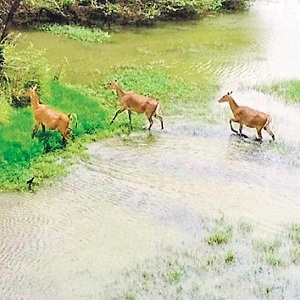
Indirect Sightings of Animals Recorded in River Transect Walk
S.No. |
Name of the Species |
Indirect Evidence |
Encounter Rate/km |
% Encounter Rate |
|---|---|---|---|---|
| 1 | Tiger (Panthera tigris) | 7 | 0.2 | 2.4 |
| 2 | Leopard (Panthera pardus) | 5 | 0.1 | 1.7 |
| 3 | Sloth Bear (Melursus ursinus) | 10 | 0.2 | 3.4 |
| 4 | Wild Dog or Dhole (Cuon alpinus) | 4 | 0.1 | 1.4 |
| 5 | Striped Hyena (Hyena hyena) | 2 | 0.0 | 0.7 |
| 6 | Chital (Axis axis) | 70 | 1.5 | 23.8 |
| 7 | Sambar (Rusa unicolor) | 26 | 0.6 | 8.8 |
| 8 | Blackbuck (Antilope cervicapra) | 2 | 0.0 | 0.7 |
| 9 | Black-naped Hare (Lepus nigricollis) | 3 | 0.1 | 1.0 |
| 10 | Asiatic Elephant (Elephas maximus) | 101 | 2.2 | 34.4 |
| 11 | Gaur (Bos gaurus) | 5 | 0.1 | 1.7 |
| 12 | Feral Buffalo (Bubalus sp.) | 12 | 0.3 | 4.1 |
| 13 | Wild Pig (Sus scrofa) | 6 | 0.1 | 2.0 |
| 14 | Indian Porcupine (Hystrix indica) | 17 | 0.4 | 5.8 |
| 15 | Bonnet Macaque (Macaca radiata) | 3 | 0.1 | 1.0 |
| 16 | Oriental Small-clawed Otter (Aonyx cinerea) | 6 | 0.1 | 2.0 |
| 17 | Bengal Monitor Lizard (Varanus bengalensis) | 1 | 0 | 0.3 |
| 18 | Marsh Crocodile (Crocodylus palustris) | 14 | 0.3 | 4.8 |
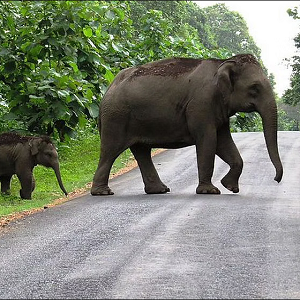
Direct Sightings of Animals Recorded in River Transect Walk
S.No. |
Name of the Species |
# sightings |
# individuals |
Mean group size |
Encounter Rate/km |
|---|---|---|---|---|---|
| 1 | Chital (Axis axis) | 9 | 110 | 12.2 | 2.39 |
| 2 | Sambar (Rusa unicolor) | 3 | 6 | 2 | 0.13 |
| 3 | Blackbuck (Antilope cervicapra) | 3 | 6 | 2 | 0.13 |
| 4 | Asiatic elephant (Elephas maximus) | 3 | 11 | 3.7 | 0.24 |
| 5 | Gaur (Bos gaurus) | 3 | 8 | 2.7 | 0.17 |
| 6 | Feral Buffalo (Bubalus sp.) | 4 | 37 | 9.25 | 0.81 |
| 7 | Wildpig (Sus scrofa) | 2 | 3 | 1.5 | 0.07 |
| 8 | Bonnet Macaque (Macaca radiata) | 12 | 86 | 7.17 | 1.87 |
| 9 | Tufted Gray langur (Semnopithecus priam) | 13 | 159 | 12.23 | 3.46 |
| 10 | Indian Giant Squirrel (Ratufa indica) | 6 | 7 | 1.17 | 0.15 |
| 11 | Oriental small-clawed otter (Aonyx cinerea) | 1 | 2 | 2 | 0.04 |
| 12 | Bengal Monitor Lizard (Varanus bengalensis) | 3 | 3 | 1 | 0.07 |
| 13 | Marsh Crocodile (Crocodylus palustris) | 10 | 14 | 1.4 | 0.30 |
| 14 | Indian Rock Python (Python molurus molurus) | 1 | 1 | 1 | 0.02 |
List of Riparian Plants Found Along River Moyar
S.No. |
Family |
Species |
Habit |
Nativity |
|---|---|---|---|---|
| 1 | Combretaceae | Terminalia cuneata Roxb | Tree | Native |
| 2 | Fabaceae | Pongamia pinnata (L.) Pierre | Tree | Native |
| 3 | Myrtaceae | Syzygium cumini (L.) Skeels | Tree | Native |
| 4 | Ebenaceae | Diospyros malabarica (Desr.) Kostel. | Tree | Native |
| 5 | Euphorbiaceae | Homonoia riparia Lour. | Shrub | Native |
| 6 | Sapotaceae | Madhuca neriifolia (Moon) H.J. Lam. | Tree | Native |
| 7 | Euphorbiaceae | Trewia nudiflora L. | Tree | Native |
| 8 | Anacardiaceae | Mangifera indica L. | Tree | Native |
| 9 | Melastomataceae | Memecylon umbellatum Burm. | Tree | Native |
| 10 | Poaceae | Bambusa bambos Voss | Tree | Native |
| 11 | Rubiaceae | Ixora pavetta Andr. | Tree | Native |
| 12 | Lythraceae | Lagerstroemia microcarpa Wight | Tree | Native |
| 13 | Meliaceae | Azadirachta indica A. Juss. | Tree | Burma |
| 14 | Caesalpiniaceae | Bauhinia racemosa Lam. | Tree | Native |
| 15 | Sapindaceae | Schleichera oleosa (Lour.) Oken | Tree | Native |
| 16 | Rubiaceae | Canthium coromandelicum (Burm. F.) Alston | Shrub | Native |
| 17 | Meliaceae | Aglaia elaeagnoidea (Juss.) Benth. | Tree | Native |
| 18 | Celastraceae | Pleurostylia opposita (Wall.) Alston | Tree | Native |
| 19 | Celastraceae | Cassine glauca (Rottb.) Kuntze | Tree | Native |
| 20 | Bignoniaceae | Stereospermum colais (Buch.-Ham. ex Dillw.) Mabb. | Tree | Native |
| 21 | Rhamnaceae | Ziziphus mauritiana Lam. | Tree | Native |
| 22 | Salicaceae | Salix tetrasperma Roxb. | Tree | Native |
| 23 | Loganiaceae | Strychnos nux-vomica L. | Tree | Native |
| 24 | Rubiaceae | Pavetta indica L. ex K. Schum. | Shrub | Native |
| 25 | Verbenaceae | Vitex leucoxylon L.f. | Tree | Native |
| 26 | Fabaceae | Dalbergia latifolia Roxb. | Tree | Native |
| 27 | Solanaceae | Datura sanguinea Ruiz & Pavon | Shrub | Tropical America |
| 28 | Rubiaceae | Mitragyna parvifolia (Roxb.) Korth. | Tree | Native |
| 29 | Euphorbiaceae | Phyllanthus polyphyllus Willd. | Tree | Native |
| 30 | Verbenaceae | Vitex altissima L.f. | Tree | Native |
| 31 | Euphorbiaceae | Drypetes roxburghii (Wall.) Hurusawa | Tree | Native |
| 32 | Caprifoliaceae | Viburnum punctatum Buch. - Ham. ex D. Don | Liane | Native |
| 33 | Tiliaceae | Grewia tiliifolia Vahl. | Tree | Native |
| 34 | Mimosaceae | Prosopis juliflora (Sw.) Dc. | Tree | Tropical America |
| 35 | Myrtaceae | Psidium guajava L. | Tree | Native |
| 36 | Rhamnaceae | Ziziphus oenoplia (L.) Mill. | Liane | Native |
| 37 | Combretaceae | Terminalia elliptica Willd. | Tree | Native |
| 38 | Boraginaceae | Cordia monoica Roxb. | Tree | Native |
| 39 | Rutaceae | Glycosmis mauritiana (Lam.) Tanaka | Shrub | Native |
| 40 | Caesalpiniaceae | Tamarindus indica L. | Tree | Tropical Africa |
| 41 | Ulmaceae | Celtis timorensis Spanoghe | Tree | Native |
| 42 | Melastomataceae | Memecylon grande Retz. | Tree | Native |
| 43 | Rutaceae | Atalantia monophylla (L.) Correa | Tree | Native |
| 44 | Euphorbiaceae | Jatropha curcas L. | Shrub | Tropical America |
| 45 | Caesalpiniaceae | Cassia fistula L. | Tree | Native |
| 46 | Rubiaceae | Psydrax dicoccos Gaertn. | Tree | Native |
| 47 | Oleaceae | Olea dioica Roxb. | Tree | Native |
| 48 | Rutaceae | Pleiospermium alatum Swingle | Tree | Native |
| 49 | Euphorbiaceae | Bischofia javanica Blume | Tree | Native |
| 50 | Moraceae | Ficus microcarpa L.f. | Tree | Native |
| 51 | Sapotaceae | Mimusops elengi L. | Tree | Native |
| 52 | Meliaceae | Cipadessa baccifera (Roth) Miq. | Tree | Native |
| 53 | Mimosaceae | Entada pursaetha DC. | Liane | Native |
| 54 | Verbenaceae | Lantana camara L. | Shrub | Tropical America |
| 55 | Tiliaceae | Grewia serrulata DC. | Tree | Native |
| 56 | Burseraceae | Garuga pinnata Roxb. | Tree | Native |
| 57 | Verbenaceae | Premna latifolia Rozb. var. latifolia | Tree | Native |
| 58 | Bignoniaceae | Radermachera xylocarpa (Roxb.) K.Schum. | Tree | Native |
| 59 | Euphorbiaceae | Phyllanthus emblica L. | Tree | Native |
| 60 | Dipterocarpaceae | Shorea roxburghii G. Don. | Tree | Native |
| 61 | Moraceae | Ficus hispida L.f. | Tree | Native |
| 62 | Caesalpiniaceae | Cassia spectabilis DC. | Tree | Tropical America |
| 63 | Salvadoraceae | Salvadora persica L. | Tree | Native |
| 64 | Euphorbiaceae | Aporosa acuminata Thw. | Tree | Native |
| 65 | Rubiaceae | Catunaregam spinosa (Thunb.) Tirvengadum | Tree | Native |
| 66 | Loganiaceae | Strychnos potatorum L. | Tree | Native |
| 67 | Combretaceae | Combretum albidum G. Don | Liane | Native |
| 68 | Fabaceae | Dalbergia paniculata Roxb. | Tree | Native |
| 69 | Ebenaceae | Diospyros montana Roxb. | Tree | Native |
| 70 | Rhamnaceae | Ziziphus xylopyrus (Retz.) Willd. | Tree | Native |
| 71 | Sapindaceae | Sapindus emarginatus Vahl | Tree | Native |
| 72 | Caesalpiniaceae | Senna occidentalis (L.) Link | Shrub | Tropical America |
| 73 | Euphorbiaceae | Breynia vitis-idaea (Burm.f.) Fischer | Shrub | Native |
| 74 | Meliaceae | Walsura trifolia (A. Juss.) Harms | Tree | Native |
| 75 | Erythroxylaceae | Erythroxylum monogynum Roxb. | Tree | Native |
| 76 | Sapindaceae | Filicium decipiens (Wight & Arn.) Thw. | Tree | Native |
| 77 | Verbenaceae | Tectona grandis L.f. | Tree | Native |
| 78 | Combretaceae | Anogeissus latifolia (Roxb. Ex DC.) Wall | Tree | Native |
| 79 | Caesalpiniaceae | Senna didymobotrya (Fresn.) Irwin & Barneby | Shrub | Non Native |
| 80 | Smilacaceae | Smilax zeylanica L. | Shrub | Native |
| 81 | Rutaceae | Chloroxylon swietenia DC. | Tree | Native |
| 82 | Boraginaceae | Cordia obliqua Willd. | Tree | Native |
| 83 | Sterculiaceae | Helicteres isora L.ShrubNative | ||
| 84 | Hernandiaceae | Gyrocarpus asiaticus Willd. | Tree | Native |
| 85 | Combretaceae | Terminalia bellirica (Gaertn.) Roxb. | Tree | Native |
| 86 | Apocynaceae | Carissa carandas L. | Shrub | Native |
| 87 | Celastraceae | Maytenus heyneana (Roth) Raju & Babu | Shrub | Native |
| 88 | Simaroubaceae | Ailanthus excelsa Roxb. | Tree | Native |
| 89 | Euphorbiaceae | Phyllanthus reticulatus Poir. | Shrub | Native |
| 90 | Rubiaceae | Psilanthus wightianus (Wight & Arn.) J. Leroy | Shrub | Native |
| 91 | Myrtaceae | Syzygium tamilnadensis Rathakr. & Chithra | Tree | Native |
| 92 | Mimosaceae | Albizia lebbeck (L.) Willd. | Tree | Native |
| 93 | Bixaceae | Bixa orellana L. | Tree | Tropical America |
| 94 | Euphorbiaceae | Glochidion zeylanicum (Gaertn.) Juss. | Tree | Native |
| 95 | Ulmaceae | Trema orientalis (L.) Blume | Tree | Native |
| 96 | Moraceae | Ficus benjamina L. | Tree | Malaysian |
| 97 | Myrsinaceae | Ardisia solanacea Roxb. | Tree | Native |
| 98 | Bignoniaceae | Dolichandrone atrovirens Sprague | Tree | Native |
| 99 | Moraceae | Ficus benghalensis L. | Tree | Native |
| 100 | Euphorbiaceae | Ricinus communis L. | Shrub | Tropical America |
| 101 | Moraceae | Ficus tsjahela Burm.f. | Tree | Native |
| 102 | Fabaceae | Derris scandens (Roxb.) Benth | Liane | Native |
| 103 | Meliaceae | Swietenia mahagoni (L.) Jacq. | Tree | Native |
| 104 | Mimosaceae | Albizia amara (Roxb.) Boivin | Tree | Native |
| 105 | Burseraceae | Commiphora caudata (Wight & Arn.) Engler | Tree | Native |
| 106 | Caesalpiniaceae | Delonix regia (Boj. ex Hook) Rafin. | Tree | South East Asia |
| 107 | Ebenaceae | Diospyros ferrea (Willd.) Bakh. | Shrub | Native |
| 108 | Moraceae | Ficus mollis Vahl | Tree | Native |
| 109 | Euphorbiaceae | Givotia rottleriformis Griff. | Tree | Native |
| 110 | Tiliaceae | Grewia hirsuta Vahl. | Shrub | Native |
| 111 | Olacaceae | Olax scandens Roxb. | Liane | Native |
| 112 | Euphorbiaceae | Bridelia crenulata Roxb. | Tree | Native |
| 113 | Poaceae | Dendrocalamus strictus (Roxb.) Nees | Shrub | Native |
| 114 | Fabaceae | Erythrina variegata L. | Tree | Native |
| 115 | Moringaceae | Moringa concanensis Nimmo ex Gibs. | Tree | Native |
| 116 | Rubiaceae | Wendlandia thyrsoidea (Schultes) Steud. | Shrub | Native |
| 117 | Rhamnaceae | Ziziphus glabrata Heyne ex Roth | Tree | Native |
| 118 | Mimosaceae | Acacia leucophloea (Roxb.) Willd. | Tree | Native |
| 119 | Alangiaceae | Alangium salvifolium (L.f.) Wang. | Tree | Native |
| 120 | Mimosaceae | Albizia saman (Jacq.) F.v. Muell. | Tree | Tropical America |
| 121 | Bignoniaceae | Dolichandrone arcuata (Wight) Clarke | Tree | Native |
| 122 | Bignoniaceae | Dolichandrone falcata (Wall.ex DC.) Seem. | Tree | Native |
| 123 | Moraceae | Ficus racemosa L. | Tree | Native |
| 124 | Flacourtiaceae | Flacourtia ramontchi L' Hér | Tree | Native |
| 125 | Lythraceae | Lawsonia inermis L. | Shrub | Native |
| 126 | Rubiaceae | Morinda pubescens J.E. Smith | Tree | Native |
| 127 | Pandanaceae | Pandanus odoratissimus L.f. | Shrub | Native |
| 128 | Euphorbiaceae | Phyllanthus indofischeri Bennet | Tree | Native |
| 129 | Anacardiaceae | Spondias pinnata (L.f.) Kurz | Tree | Native |
| 130 | Apocynaceae | Wrightia arborea (Dennst.) Mabberley | Tree | Native |
| 131 | Apocynaceae | Wrightia tinctoria (Roxb.) | Tree | Native |
Sensitizing Media Professionals on Tiger Conservation
Date: May 6-8, 2011
Venue: Parambikulam Tiger Reserve
Organisers: Arulagam, PSG College of Arts and Science, Wildlife Conservation Society and Centre for Wildlife Studies (CWS).
Target Group: Media Students from 16 Colleges and Universities of Tamil Nadu and Pondicherry.
Purpose: Sensitizing the Media professionals on conserving Tigers and its habitat in Tamil Nadu.
Medium: Presentation, Field trips, Group Discussions, Screening Films, interaction with Wildlife scientists and Conservation practitioners.
Funding / Collaboration: CWS
C.R.Jayaprakash, Assistant Professor, Dept., of Communication, PSG College of Arts and Science, Coimbatore was the project coordinator of the workshop.
Sensitizing Media Students on Tiger Conservation
Date: Feb 25-27, 2011
Venue: PSG Auditorium and Topslip, Anamalai Tiger Reserve
Organisers: Arulagam, PSG College of Arts and Science, Wildlife Conservation Society and Centre for Wildlife Studies (CWS).
Target Group: Media Students from 16 Colleges and Universities of Tamil Nadu and Pondicherry.
Purpose: Sensitizing about the role of media in Tiger Conservation.
Medium: Presentation, Field trips, Group Discussions, Screening Films, interaction with wildlife scientist, photographers and film makers.
Funding / Collaboration: CWS
Inaugural session:
Wildlife Conservation Society – India Program sponsored workshop on “Sensitizing the media on conserving tigers and their habitat in Tamil Nadu” was inaugurated at PSG COLLEGE OF ARTS AND SCIENCE, Coimbatore on the 25th of February, 2011.
Dr.K.M. Chinnadorai, Principal in charge, PSG College of Arts and Science, Coimbatore welcomed the audience.
Dr.Raja Jayapal, Conservation Scientist, WCS - India program made a brief report on Wildlife Conservation Society-India Program project in Tamil Nadu.
Poster release on TIGER CONSERVATION followed through and was released by Mr.G.Rangaswamy, Managing Trustee, PSG Institutions and Dr.Ravi Chellam, Country Director, Wildlife Conservation Society-India program.
Mr.G.Rangaswamy addressed the audience on the need for conservation and the civil and political support conservation initiatives required.
Dr.Ravi Chellam delivered the keynote address and centered his talk on Human-wildlife relationship and conflict. The reason for conflict and mitigating measures were also discussed. He also emphasized on the lack of information based conflict management measures.
The inauguration came to a close with the vote of thanks by C.R.Jayaprakash, Assistant Professor, Dept., of Communication, PSG College of Arts and Science, Coimbatore. He was also the project coordinator of the workshop.
Workshop:
The first session of the workshop commenced with a presentation of "Wildlife photography versus Conservation Photography" by Dr. R.Tolstoy, Associate Professor, PSG Institute of Medical Sciences and Research, Coimbatore - 641 004. Dr.Tolstoy spoke of how photography could effectively help conservation and have minimal impact on the environment it works on. He also spoke of Tribal welfare and the impact of a happy tribal population on the environment. Environmentally sensitive behavior and scientifically informed conservation photography was emphasized.
The session came to a close with a talk by Mr. Mohammad Ali, Member of The Nature Trust, Mettupalayam, on ‘Myths, Media and Wildlife reporting’. Responsible journalism and well researched reporting on wildlife issues were discussed in detail. The need to understand ones own environment, its structure and function was encouraged. Ali’s talk set a preamble to the workshop were in participants were encouraged to discern the information gathered during the workshop and come up with a unbiased perception of wildlife and conservation.
Workshop continued at Anamalai Tiger Reserve (ATR)
The workshop at Anamalai Tiger Reserve began with the screening of “The Truth about Tigers” by Shekar Dattatri, Wildlife Filmmaker and Conservationist, to an audience of 30, all were participants selected from 16 Colleges and Universities of Tamil Nadu and Pondicherry. The movie covered some significant aspects of Tiger conservation, the need to conserve Tigers and the issue of conservation at large.
The documentary followed with a discussion. Dr Ravi Chellam and Shekar Dattatri spear headed the discussion by bringing forth a number of conservation issues and media’s perception and projection of such issues. Responsible and informed journalism was announced to be the need of the hour.
A number of ways by which media could bring forth a well researched piece of information on marauding conservation issues were discussed. The participants raised a number of questions on issues ranging from the types of forests found in India, tiger-favored ecosystem, radio-collaring of tigers, tiger census, human-tiger conflict and human perception of conservation and tigers.
Dr.V. Manoharan, Forest Veterinary Officer, Coimbatore and Thangaraj Panneerselvam, Forest Range Officer, Ullandy, Analmalai Tiger Reserve met with the participants. Mr.Thangaraj Panneerselvam made a short presentation on Anamalai Tiger Reserve while Dr Manoharan spoke of wild-animal disease control and treatment.
Day 2: On 26th February, 2011 the participant’s begun the workshop with a trek to Karian Shola, in Anamalai Tiger Reserve. The participants spotted a few endemic birds and noted a number of bird sounds. One of the groups spotted the endemic Great Indian Hornbill and the Racket tailed drongo. Malabar giant squirrel, Indian Gaur, and Nilgiri langurs were the few mammals sighted.
A talk by Mr. Shekar Dattatri followed. Mr. Dattatri elaborated on the role of Forest department as essential guardians of forest and their inevitability in the conservation system. Human- animal conflict, conflict control, mitigation measures, and human perception of conservation were amongst the important topics discussed. The role of media in reporting such conflicts, unbiased reporting and conservation issue discussion by the media were discussed using contemporary illustrations and examples.
Dr. Chellam delivered the second lecture followed by a discussion. He argued upon the serious lack in conservation training for forest officials and for the lower grade forest watchers and anti-poaching guards. Resource provision in terms of monetary benefits and other concessions as beneficial encouragements for the lower grade forest watchers and anti-poaching guards was also emphasized. Dr Chellam spoke briefly about the WCS Initiative and its research interest.
The participants then took a tour around Parambikulam Tiger Reserve, Kerala, which lies adjacent to ATR. This was to give the participants a general idea of the topography of the reserve and of the mythical “jungle” itself. The participants witnessed the reality of managed forests and the human influence it had to cope with. The tour included a visit to the famous Kannimara teak: the Virgin tree with its own history and folk perceptions.
The day ended with the screening of Shekar Dattatri’s documentary ‘Save our Sholas’. The discussion that followed saw participants come up with some exciting and intriguing questions on shola forests and its importance in sustaining both the wild and the human world. Before the film, C.R.Jayaprakash, Project Coordinator of the workshop presented images of faulty management of forest resources and strain on forest resources which are illegally promoted in the name of Eco Tourism.
Day 3:
The day began with a field tour into the Parambikulam Tiger Reserve. A number of birds including the Orange and black flycatcher, Male Paradise flycatcher and Malabar Pied hornbills were sighted. Mammals such as the Giant Malabar Squirrel and Indian Gaur, Spotted Deer, Sambar Deer were also sighted.
K. Vijayananthan IFS, Wildlife Warden, Parambikulam Tiger Reserve, and H.Basavaraju, IFS, Field Director, Anamalai Tiger Reserve briefed the audience on the history of Parambikulam and Anamalai Tiger Reserve. Conservation issues such as poaching, poacher-forest watcher clashes, wildlife traffic, sale nexus and wildlife laws were also discussed. The participants interacted with the officials and raised a number conservation issues including the building of check dams and its implications on the environment and the ecosystem.
Dr. Raja Jayapal, Conservation Scientist, WCS delivered the concluding talk. Research as an aspect of conservation issue reporting and the consequences of negligence of research was discussed. Unbiased issue discussion and a follow up of the issue were encouraged as an effective tool that could aid in conservation. Tiger as an efficient flag ship species for conservation and thus the need to sensitize media on the conservation of Tigers was emphasized.
The workshop ended with a feedback session headed by Dr. Ravi Chellam. The participants candidly spoke of the few aspects of the workshop that needed rethinking and readjustments while lauding many others they appreciated, such as the availability and approachability of conservation connoisseurs like Dr Chellam and Mr. Dattatri.
C.R. Jayaprakash gave away the vote of thanks thus calling the workshop to a close. He announced special prizes to the participants who take the message gathered from the workshop to the Media. Any news items in mainline dailies, Short films/Documentaries or even Posters on Tiger Conservation made by the participants would be awarded with prizes worth Rs.5,000. The cut off date for submission was announced as May 31, 2011.
Follow up:
The first entry in this category, a poster by George Joseph Thengumootil, I MA Communication, PSG CAS was received in the first week of March, 2011. As an Early Bird entry offer, this participant stands selected to the second Workshop which is planned in the first week of May, 2011.
Working Journalists from the Print and Electronic Media of Tamil Nadu will be invited/Selected for the second residential workshop which will be an improvement on the first camp.
Page 21 of 25