
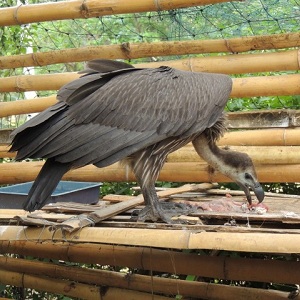
White-backed vulture chick rescue, rehabilitation and release
Written by S. Bharathidasan and Mrs. Vaidehi Herbert
On September 7, the International Vulture Awareness Day aimed to bring awareness to vulture conservation activities and the threats that some species are facing. Here S. Bharathidasan from Arulagam, an NGO working towards the conservation of fauna and flora in Tamil Nadu, India, writes about his recent experience saving a white-backed vulture chick.
A robust scavenger, the Critically Endangered white-backed vulture (Gyps bengalensis) was once described as “possibly the most abundant large bird of prey in the world.” But an extremely rapid population decline (more than 99 percent) resulted from the birds ingesting the carcasses of animals treated with Diclofenac, an anti-inflammatory drug used to treat domestic livestock.
With the support of CEPF through its investment in the Western Ghats Region of India, Arulagam and Saving Asia’s Vulture from Extinction (SAVE) have devised a plan for a vulture safe zone – an area around Moyar Valley in India with a radius of up to 100 kilometers where vultures can find food that is diclofenac free.
Earlier this year, while searching for vultures with the Arulagam vulture research team near Thalamalai, India, a vulture chick that had fallen from its nest was discovered by vulture volunteers in Siriur. Unable to fly, the chick needed rescuing immediately. Although rushing to Siriur meant that I had to put off finishing a report due to the Ministry of Environment and Forest, the vulture chick rescue was the most important matter to me.
When we reached Masinakudi, a 3.5-hour car ride away from where we were, I bought glucose water and goat meat for the vulture chick, which was sent with the team. I had completed my report during the car ride, so I went to email the report, and then catch a bus to join the rescue team in Siriur. By the time I reached the team that night, the chick had been taken to the forest guards’ quarters. We worked with the forest department staff to cut bamboo, stripping its leaves, to make a nest for the chick. We then checked the chick for wounds and bruises, checked its stool and weighed the bird. Luckily, everything seemed to be okay. Because the chick weighed only 2.7 kilograms (approximately 6 pounds), we estimated it to be around 90 days old and determined that its wings were not fully grown.
Before this, I had only seen vulture chicks through binoculars. It was absolutely delightful to see the chick now in such close quarters. In rescue situations, it is traditional to make a fake bird that looks like an adult vulture and feed food to the chick through its beak. There are two benefits to this method: the chick will eat without fear or shyness, and unnecessary contact with humans can be avoided so they can survive when released and not be dependent on humans. We were unable to do that in this case, so I held the chick and attempted to feed it pieces of chopped up goat meat that were soaked in glucose water.
The next day Dr. Manoharan, a wildlife veterinarian, came and confirmed that the chick was healthy. He praised our rescue efforts and suggested that we feed the chick different kinds of meat, instead of the same kind every day. I then got in touch with veterinarian Jeganmohan, a friend of Arulagam, who suggested the homeopathy medicine Aconyte for the chick to help reduce the shock effects from falling from its nest. He sent this by courier service and we mixed it in glucose water and added it to the meat that we fed the chick.
After considering the targeted weight for the chick, we decided that we needed to feed it 600 grams (approximately 1.3 pounds) of meat a day, which we split into two meals. Since using Diclofenac for cattle has not stopped completely, we decided to feed the chick only goat or pig meat. However, this was not so simple, due to the cost of goat meat and because we had to travel 27 kilometers to Masinakudi by bus. We struggled since the bus left in the morning and returned only in the evening.
Having no refrigerator also presented problems. If we bought meat and left it out, it would become rotten or it might draw the attention of meat-eating wild animals. Nobody around had a refrigerator either, so even though it was expensive, we brought one from the Arulagam office. A family in the village happily offered their house to place the refrigerator.
We appointed a vulture watcher to protect and feed the chick. We also asked to be informed if any cattle in town died naturally or were killed by a tiger, but the local culture did not allow us to feed a dead cow’s meat to the chick. We then arranged for a meat shop owner to send meat once every three days.
Within two days, the chick started to eat on its own. In 18 days, it started to hold meat pieces with its feet and tear them apart, so we threw larger pieces into its cage. Once the chick weighed 3.1 kilograms (approximately 7 pounds), we increased the food to one kilogram (approximately 2 pounds) a day. We avoided human contact as much as we could, since we didn’t want the chick to start relying on people for food.
The chick needed a larger space to spread its wings and learn to fly. To build a bigger cage nearby, the vulture brigades volunteers who spread the word about vulture conservation and the dangers of Diclofenac – and volleyball players from Anaikatti and Siriyur joined us to place bamboo crossbars together. We used old volleyball nets to protect the cage.
We gently moved the chick to the new cage, where it spread and turned its wings in happiness. Since the chick was too young for us to determine its sex, we tagged it with an identification ring that the Bombay Natural History Society provided. This would allow us to easily identify the chick once released and determine its sex once it has matured.
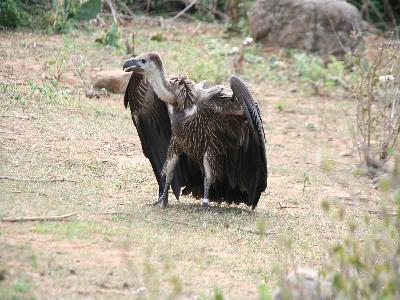
After 85 days, the chick was released. It was a memorable event for all of us. Initially the bird struggled, but then it slowly gained the ability to fly, and settled on a nearby tree. For four days the chick remained on the tree without eating, and on the fifth day it circled the sky and moved into the forest. Our team is now trying to track the chick.
This rescue was a new experience for Arulagam and me. We were totally involved with the chick for three months and it gave us a lot of mental satisfaction. Since only a little more than 100 white-backed vultures live in the Moyar region in southern India, every effort must be made to protect them. By rescuing this chick, we were helping ensure the survival of the species. We were not worried about victory or failure, nor did we calculate the money spent. We looked at this chick as a member of the continuous life chain and trusted that from this one, a thousand will come.
This was a group effort and I want to offer sincere thanks to the following people for their support and encouragement during the rescue period:Mr.Sukirtharaj Kovilpillai, district forest officer, Nilgiri North; Mr. Sivamani,assistant conservator of forest; Mr.R. Chellathurai, ranger, Siriyur; Mr.Sivakumar, Forester, ornithlogists Dr. Ranjit.Daniels(Care Earth Trust), Mr.C.Sasikumar (Malabar Natural History Society) and Dr. Raja Jeyapal (Salimali Center for Ornithology and Natural History); Mr.Mohanraj and Mr. Boominathan of World Wide Fund for Nature- India; Mr.Lokesh Kalyanasundaram (Coimbatore); Mr.M.Lenin Family; Mr.Balaji (Velicham); Mr.Amsa(Thiruppur); Mr.Melkis Raja; Mr. Raghunath (Artist); Arulagam team Mr.Venkatachalam; Mr.Anup; Ms.Revathi; Anaikkatti and Siriyur volleyball players; miva (for sponsoring transportation); Forest staff Mr.Rajagopal, Mr.B.Jaiganesh, Mr.R.Kannan, Mr.Prakash, Mr. Gunasekar and all the other forest staff who helped us; Our Special thanks to Mr.Pasavan (plot watcher) and Karthi (Volunteer).
S. Bharathidasan, secretary of Arulagam, is the project leader of the CEPF-funded project “Right to Soar High Again: Establishing a Vulture Safe Zone in Southern India,” which aims to establish a vulture safe zone in the Mysore-Nilgiri-Sathyamangalam landscape, where no veterinary drugs harmful to vultures are present in cattle carcasses. Arulagam will develop targeted awareness raising and community engagement activities for the vulture safe zone, and undertake participatory research to evolve a long-term strategy for vulture conservation.
Special Thanks to Mrs.Vaidehi herbert for translating this article from Tamil to English
Vulture Awareness Program at Anaikatty School
Date: September 22, 2012
Venue: Primary School, Anakatty Tribal Village, Nilgiri District
Organisers: Arulagam, Tamil Nadu Forest Department and District Education Department
Target group: Tribal primary school students and teachers
Purpose: To spread awareness about endangered vultures and threat to vulture populations because of Diclofenac drug.
Medium: Personal interaction and printed materials.
Funding / Collaboration: CEPF
Vulture Awareness Program at Ayyampalayam
Date: August 17, 2012
Venue: Ayyampalayam Village, Coimbatore
Organisers: Arulagam and NSS of Nirmala College for Women
Target group: Local villagers owning cattle, Students and Nature lovers
Purpose: To spread awareness about endangered vultures and threat to vulture populations because of Diclofenac drug.
Medium: Human chain rally, play acting, personal interaction and printed materials.
Funding / Collaboration: CEPF
Vulture Conservation Campaign at Masinagudi
Date: August 16, 2012
Venue: Masinagudi Village, Nilgiri District
Organisers: Arulagam, Tamil Nadu Forest Department and District Education Department
Target group: Local students and teachers and Nature lovers of Masinagudi
Purpose: To spread awareness about endangered vultures and threat to vulture populations because of Diclofenac drug.
Medium: Human chain rally, personal interaction and printed materials.
Funding / Collaboration: CEPF
Vulture Conservation Workshop at Bhavanisagar
Date: May 5, 2012
Venue: RIRD Training Center, Bhavanisagar
Organisers: Arulagam and Care Earth
Target group: Vulture Watchers, Students and Nature lovers
Purpose: To strengthen the capability of vulture watchers and to spread awareness about Diclofenac threat to Vultures.
Medium: Presentations, personal interaction and printed materials.
Fund / Collaboration : CEPF
Kazhuguparvai - A Vulture Exhibition at Bannari
Date: April 5, 2012
Venue: Bannariamman Temple, Sathyamanglam Wildlife Sanctuary
Organisers: Arulagam and Care Earth
Target group: Visitors of Temple festival and Nature lovers
Purpose: To spread awareness about Vultures and treats due to Diclofenac drug and poisoning of carcass.
Medium: Exhibits, personal interaction and printed materials.
Fund / Collaboration : CEPF
Vulture Conservation Exhibition at Kangayam Cattle Show
Cattle Fair: Vellakoil Date: 19 January, 2012
Venue: Pushpagiri Nagar; Karur Road, Vellakoil
Organisers: Arulagam and Senaapathy Kangayam Cattle Research Foundation, Kuttapalayam.
Target group: Cattle Owners and NGO's
Purpose of Visit: To make contacts and awareness about impact of Diclofenac on Vultures.
Medium: Announcement through Loudspeakers and personal interaction.
Fund / Collaboration : CEPF
Survey on Diclofenac use for Cattle
Arulagam utilized the chance to conserve Vulture (Pinam Thinni Kalugu) with the support and guidance of Bombay Natural History Society (BNHS) and Royal Society for Protection of Birds (RSPB) through vulture advocacy program. About 99% of vulture population dramatically declined within the last two decades in India because of wide-spread usage of anti-inflammatory drug Diclofenac and Ketoprofan.
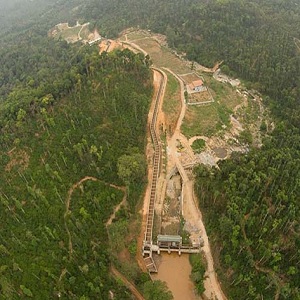
Hydroelectric Projects and their impact on the Landscape and River Moyar
Critical to the characterization process is the impact of Hydro-electric power projects in the Nilgiris, which have a distinct bearing not only on the river course and the river basin through dams and associated power houses, but also due to river course manipulation and the subsequent linkages that have been forged.
Pykara is one of the highest of south Indian streams originating in the Mukurti peak at an altitude of around 2400m ASL. It is the biggest stream in the Nilgiris Plateau. The stream flows over a number of cascades and waterfalls that it provides a drop of about 1000m before it reaches the Pykara Dam at Glenmorgan. Downstream, Pykara joins the River Moyar and eventually River Cauvery through its tributary, the River Bhavani.
The Pykara Hydroelectric Project Scheme was the first hydroelectric project that the state of Tamil Nadu (erstwhile Madras) launched and successfully implemented. The Project that was formally sanctioned during the British rule in 1929 was meant to generate and supply electricity for the industries in Coimbatore. Situated in the Nilgiris Plateau, the Pykara HP stands out as the highest in Asia and continue to be amongst the highest of hydroelectric projects in the world (source: Pell Frischmann Group and TNEB).
The Pykara Ultimate Stage Hydroelectric Project (PUSHEP) that was completed during the beginning of the 21st century was formally inaugurated in September 2005. The power generation capacity of PUSHEP is 150 MW.
Temporal and Spatial spread
The Pykara HP has been implemented in stages over a period of 75 years; PUSHEP being the final one. The spadework for the Project started in 1932. The first power-generating units were small with a capacity of 6.5 MW. Three such units were installed in the powerhouse located at Glenmorgan taking advantage of the run-of-river water alone. In order to enhance the available flow, two regulating storages were added.
These storages were located at Mukurti (upstream) and Pykara (downstream). The additional flow thus achieved enabled the installation of more power generation units. Subsequently, another storage dam was built across the Sandynallah stream. This reservoir was built to regulate and divert flows from a catchment of 44.03km² into the Pykara Dam. The network of reservoirs thus built helped achieve the set target of generating 70 MW of electricity.
In 1955, the Nilgiris Plateau experienced yet another major transformation due to the Kundah Hydroelectric Scheme. The Kundah HS led to the creation of Avalanche Dam (372m long; 57.66m high) and Emerald Dam (328.6m long; 65.72m high) around Portimund within the Kundah basin. A 733.77m long horseshoe-shaped tunnel that had the capacity to discharge 900 cusecs of water connected the two dams. The Avalanche and Emerald streams were tributaries that directly fed Pykara before the dams were constructed.Two other dams were constructed across the tributaries of Pykara in 1965; Parson’s Valley Dam (14.5km²) and Portimund Dam (10.6km²). These dams enhanced the volume of water that got diverted into the Kundah basin.
The Naduvattam Diversion Project completed in 1976 harnessed water from the 12.82km² Naduvattam basin that lies to the west of Pykara basin. In order to augment further the power generation capacity of the Pykara HP, water was diverted from the 12.95km² Lone Valley and Melkodmund stream in the Nilgiris Plateau; both streams flowed between Pykara and Sandynallah. The huge volume of water thus diverted into the Pykara Dam necessitated the enlargement of the fore bay. The enlargement of the Pykara fore bay was completed in 1978-79.
During the 1990s when the Pykara HP was in its final stage of implementation (PUSHEP) it had a well-established network of reservoirs that harnessed water from a catchment fed by Pykara, Sandynallah, Naduvattam, Melkodmund and Lone Valley streams (tributaries of River Moyar). The catchment has provided the gross storage necessary for making PUSHEP operational and generating the additional 150MW of electricity that was envisaged).
During 1946-52, the Moyar Hydroelectric Scheme was implemented. The Scheme was implemented using the tail water of the Pykara HP. The project is located at a distance of 16km downhill of the Pykara (Glenmorgan) power station. The Moyar HS also benefits by the water that is diverted from the Maravakandy Dam (located north-east of Masinagudi) through a flume channel. At Maravakandy there is a mini-hydroelectric scheme capable of producing 2.6 MW of power (Tyagi, 1995). The Maravakandy-Moyar flume channel is 6.81km long and 10.86m wide. The Moyar Ultimate Stage Hydroelectric Project (MUSHEP) that was proposed in 1995-1996 had envisaged the widening of the flume channel by another 2m. The channel that is around 2m deep had 19 bridges across it; 3 wide (5-11m), 16 narrow (1-5m) and 3 underground passages. The various hydroelectric projects that were implemented since 1932 in the Nilgiris Plateau together established a 53km network of tunnels (INO, 2007).
Page 20 of 25