Dear Vikram,
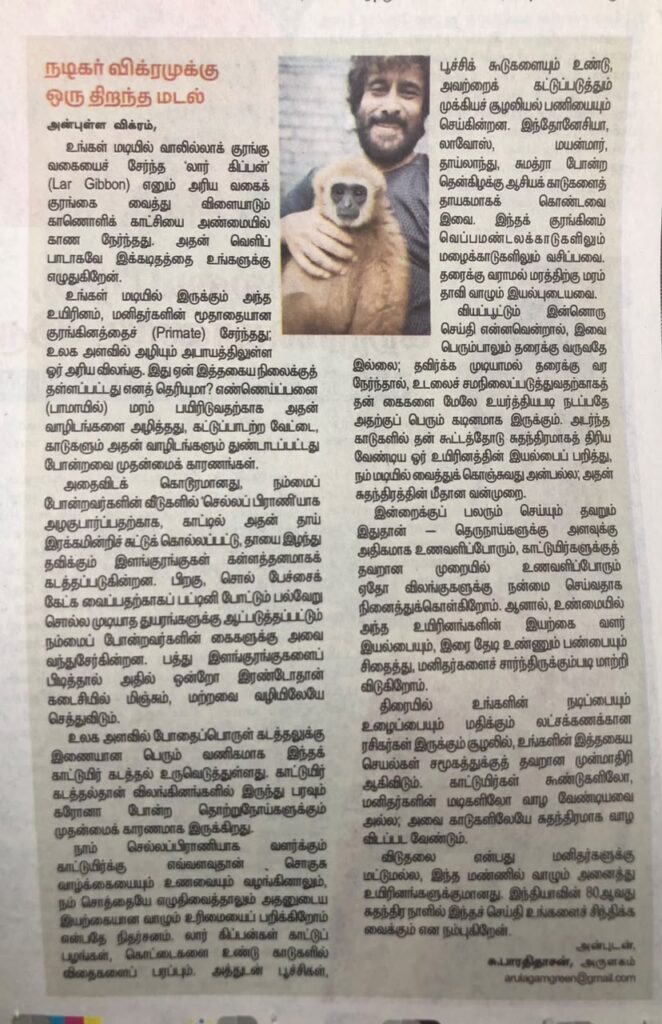
I recently came across a video (now deleted) of you playing with a rare species of ape called the ‘Lar Gibbon’ on your lap. It is in response to what I saw in that video that I am writing this letter to you.
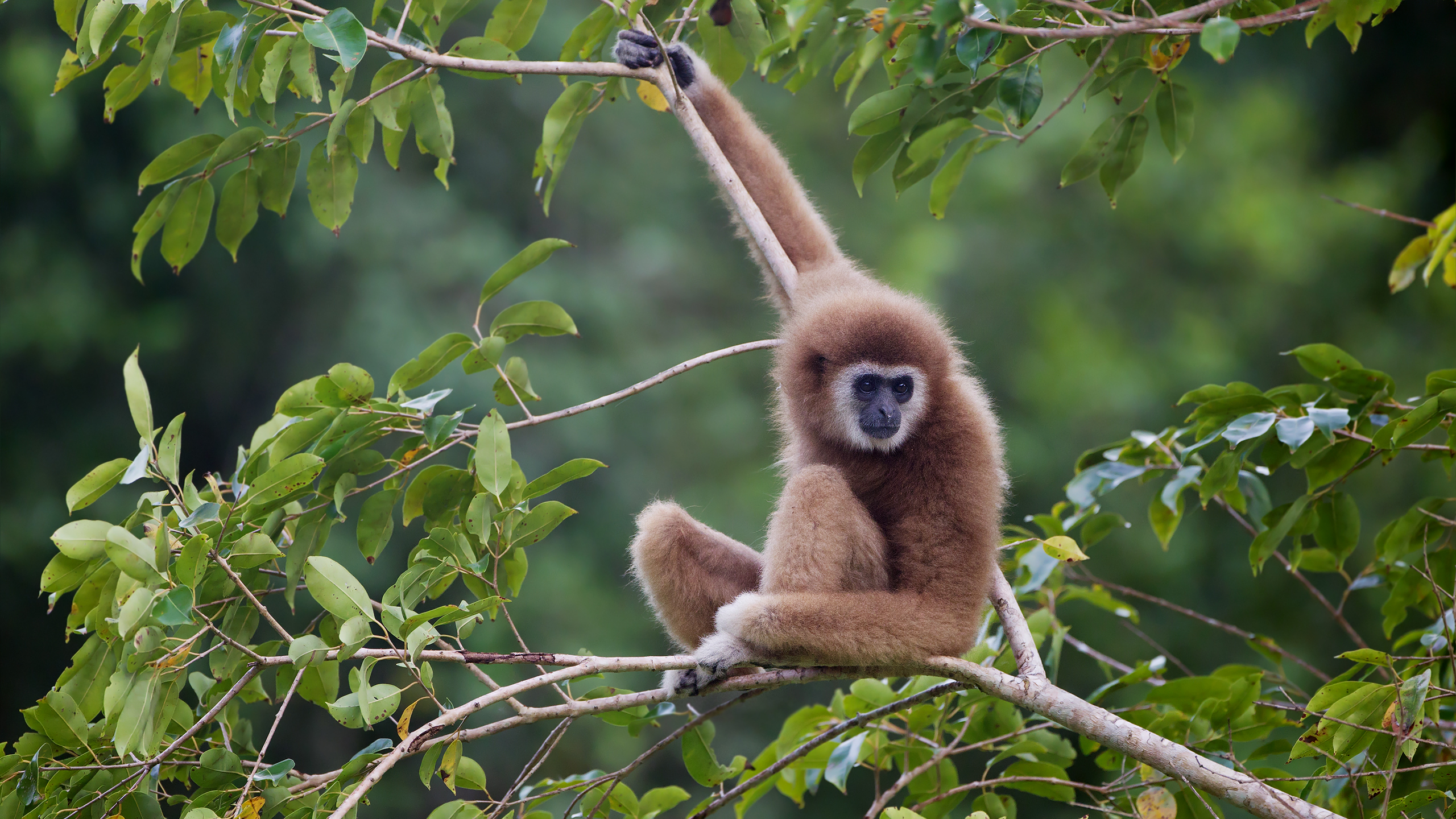
The creature you are holding on your lap is a primate, belonging to the same broad group of apes as our human ancestors; it is a very rare animal that is globally threatened with extinction. Do you know why it has been pushed to such a state?
The destruction of its habitat for the cultivation of oil palm, indiscriminate hunting, and the fragmentation of forests and their habitats are the primary reasons.
Even more horrifying is the fact that, in order to keep these animals as ‘pets’ in homes like ours and admire them for their beauty, their mothers are mercilessly shot and killed in the wild. The young ones, left helpless without their mothers, are then illegally captured and smuggled. In order to make them obey human commands, they are starved and subjected to various forms of unspeakable suffering before eventually reaching the hands of people like us. If ten young monkeys are captured, only one or two may survive in the end; the others die along the way.
Wildlife trafficking has emerged as a major global business on a scale comparable to drug trafficking. Wildlife trafficking is also a primary cause of infectious diseases transmitted from animals to humans.
No matter how much luxury, food and comfort we provide to a wild animal that we keep as a pet, and even if we were to leave our entire property to it, the truth remains that we are depriving it of its natural right to live according to its own way of life.
Lar Gibbons, which feed on wild fruits and nuts, help disperse the seeds of forest plants, and also eat insects, caterpillars and insect nests, thereby performing an important ecological function in controlling them, are native to the forests of Southeast Asia, including Indonesia, Laos, Myanmar, Thailand and Sumatra. These apes live in dry forests as well as rainforests. They are naturally adapted to living by moving from tree to tree.
Another astonishing fact is that they rarely come down to the ground. If they are unavoidably forced to do so, walking becomes extremely difficult for them, as they have to raise their arms to balance their bodies. To take away the natural way of life of a creature that should be moving freely with its own kind through dense forests and instead hold and cuddle it on our laps is not love; it is violence against its freedom!
This is also the mistake many people make today. Those who overfeed street dogs, and those who feed wild animals in inappropriate ways, often believe that they are doing something good for the animals. But in reality, we are disrupting the natural development and instinctive hunting and feeding behaviour of these animals and making them dependent on humans.
At a time when millions of fans admire your acting and hard work on screen, would such actions on your part not become a wrong example for society? Wild animals are not meant to live in cages or on the laps of humans; they should be allowed to live freely in the forests.
Freedom is not only for human beings; it is for all living beings that inhabit this earth. On the occasion of India’s 80th Independence Day, I hope this message will encourage us to think from the perspective of wild animals.
With love,
S. Bharathidasan
Arulagam
Nature Conservation Organisation