Empowering Tribal Livelihoods through Value Addition of Minor Forest Produce | Forest Wealth Development Centre | VDVK in Coimbatore District
The Forest Rights Act (FRA), 2006 marked a significant milestone in recognizing and restoring the traditional rights of tribal communities over forest resources in India. Among the key provisions of the Act is the legal entitlement of forest-dwelling communities to collect, use, and sell Minor Forest Produce (MFP), thereby enabling sustainable livelihood opportunities rooted in indigenous knowledge and forest conservation practices. However, despite this legal recognition, tribal collectors have historically remained at the lowest end of the value chain, often subjected to exploitation by intermediaries and deprived of fair market returns.
To address these systemic challenges and to translate legal rights into tangible economic empowerment, the Union Government launched the VDVK scheme. The scheme aims to strengthen tribal livelihoods by promoting collective entrepreneurship, value addition, and market access for forest produce. By enabling tribal members to move beyond raw material collection towards processing, branding, and marketing, the VDVK initiative seeks to ensure sustainable income generation and economic self-reliance.
In Tamil Nadu, the VDVK programme is implemented through the Tribal Welfare Department, with mentoring and technical support provided by empanelled civil society organisations. In Coimbatore District, Arulagam has been entrusted with the role of mentoring agency to handhold tribal communities in the establishment and operationalisation of VDVKs. This partnership reflects a collaborative approach involving government institutions and grassroots organisations to ensure effective programme implementation.
As part of the Entrepreneur Awareness Programme conducted under the initiative, Mr. Jabez John delivered the introductory session, providing an overview of Arulagam and its 23 years of work, with particular emphasis on the organisation’s long-standing efforts in conserving and advocating for lesser-known species.He informed the participants that the Tribal Welfare Department has empanelled Arulagam as the mentoring agency to support and guide the implementation of the VDVK programme in Coimbatore District, and formally introduced Mr. Mani, Master Trainer, to lead the technical sessions for the VDVK members.
As part of the initiative, two tamarind processing units have been established in Coimbatore District at a total cost of ₹14,69,808. One unit is located at Velliyangadu in Kandiyur Village, while the second unit has been set up at Annaikatty in Thuvaipathy Village. Tamarind, a commonly available forest produce in the region, holds strong market potential, making it a viable commodity for value addition and enterprise development.
Recognising that infrastructure alone is insufficient to ensure success, the programme places strong emphasis on capacity building and entrepreneurial orientation. In this context, Arulagam conducted Entrepreneur Awareness Programmes (EAPs) at Nellithurai and Senguttai villages in 21 January 2024. These programmes focused on building awareness among tribal members about business opportunities, collective enterprise models, and the economic potential of value-added forest produce.
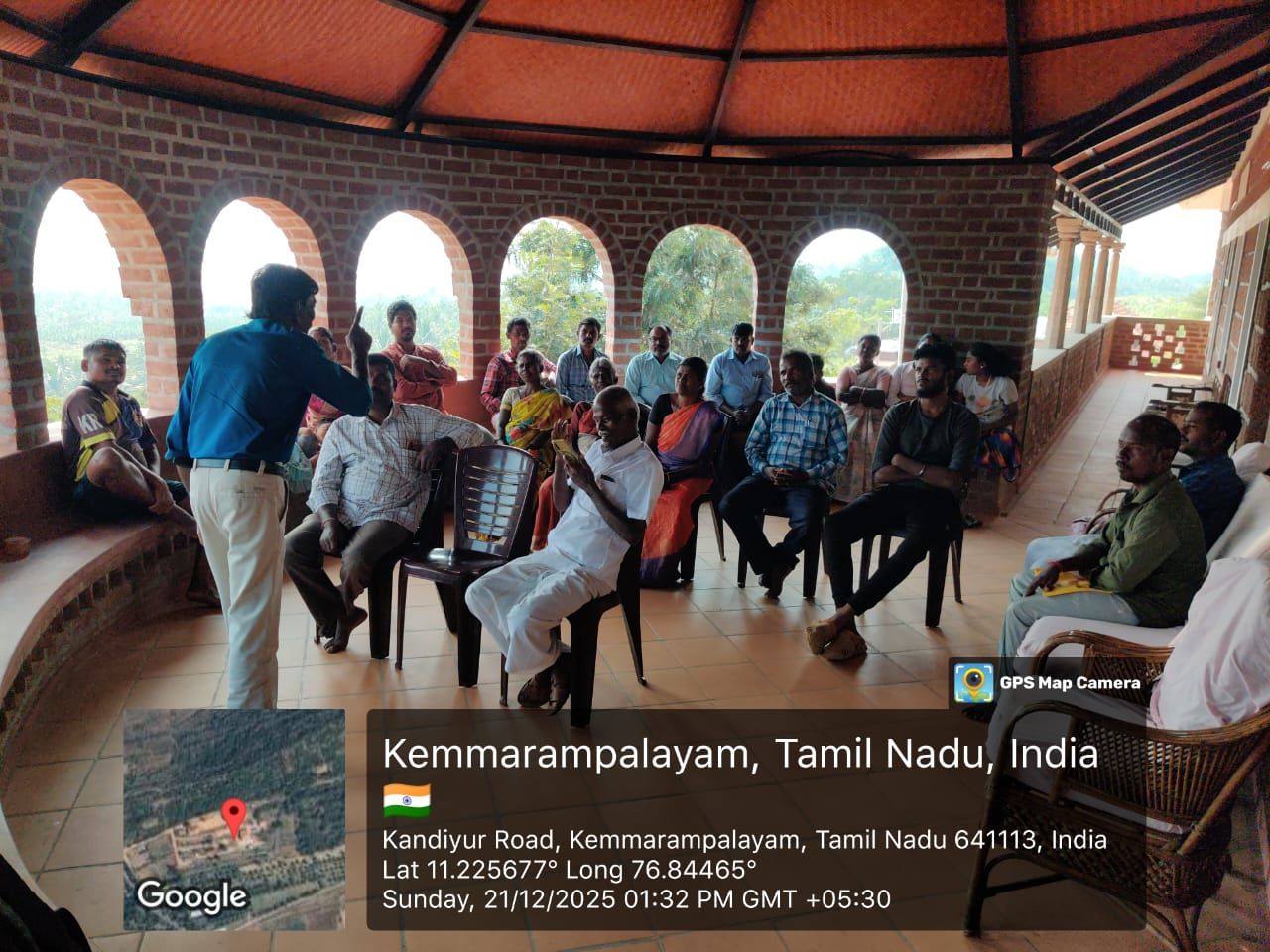
Following directions from the Tribal Welfare Department, Arulagam resumed the Entrepreneur Awareness Programme at Velliyangadu Village on 21 December 2025, specifically targeting members associated with the newly established processing unit. The session was facilitated by Mr. Mani, Master Trainer, who engaged 32 core group members of the Van Dhan Vikas Kendra through interactive discussions and practical examples drawn from local market realities.
During the programme, Mr. Mani elaborated on the existing market dynamics that disadvantage tribal producers. He explained how middlemen typically procure raw tamarind from tribal collectors at prices ranging between ₹20 and ₹22 per kilogram, and after processing and value addition, sell the same product in the market at prices as high as ₹180–200 per kilogram. This stark disparity underscores the extent of value capture by intermediaries and the urgent need for tribal communities to gain control over processing and marketing.
The VDVK initiative directly addresses this challenge by enabling tribal members to engage in value addition at the community level. Through the project, participants are expected to receive 20–30% higher returns compared to traditional raw produce sales. With access to processing machinery provided by the government, communities are encouraged to form Producer Companies or collective enterprises, strengthen their institutional capacities, and develop direct market linkages.
In addition to infrastructure support, the scheme offers a comprehensive capacity-building package, including business development training, value addition and quality control training, and exposure visits to successful enterprises. These components are designed to equip tribal members with practical skills and confidence to manage enterprises independently and sustainably.
The establishment of the tamarind processing units is also expected to generate significant local employment. Each unit is projected to provide direct employment to 15–20 tribal members by March 2026, contributing to income diversification and reducing distress migration. By fostering local enterprise development, the initiative aligns with broader goals of inclusive growth, tribal empowerment, and sustainable forest-based livelihoods.
Overall, the Van Dhan Vikas Kendra initiative in Coimbatore District represents a critical step towards translating forest rights into economic empowerment. Through strategic partnerships, capacity building, and market-oriented interventions, the programme holds the potential to transform tribal communities from raw material suppliers into empowered entrepreneurs, ensuring both livelihood security and long-term sustainability.