
Elephant Carcass Left for Scavengers like Vultures, Implementing AIWC Guidelines for Wild Animal Carcass Disposal
I was on a field visit with my team, monitoring vultures in the Thengumarahada Forest Range, when I received a call from the Forest Range Officer. He informed me that an elephant had died and asked if I could join the post-mortem as an NGO representative. The Advanced Institute for Wildlife Conservation, run by the Tamil Nadu government, had recently released an SOP on wildlife carcass disposal. I saw this as an excellent opportunity to witness these guidelines being implemented, so I immediately accepted.
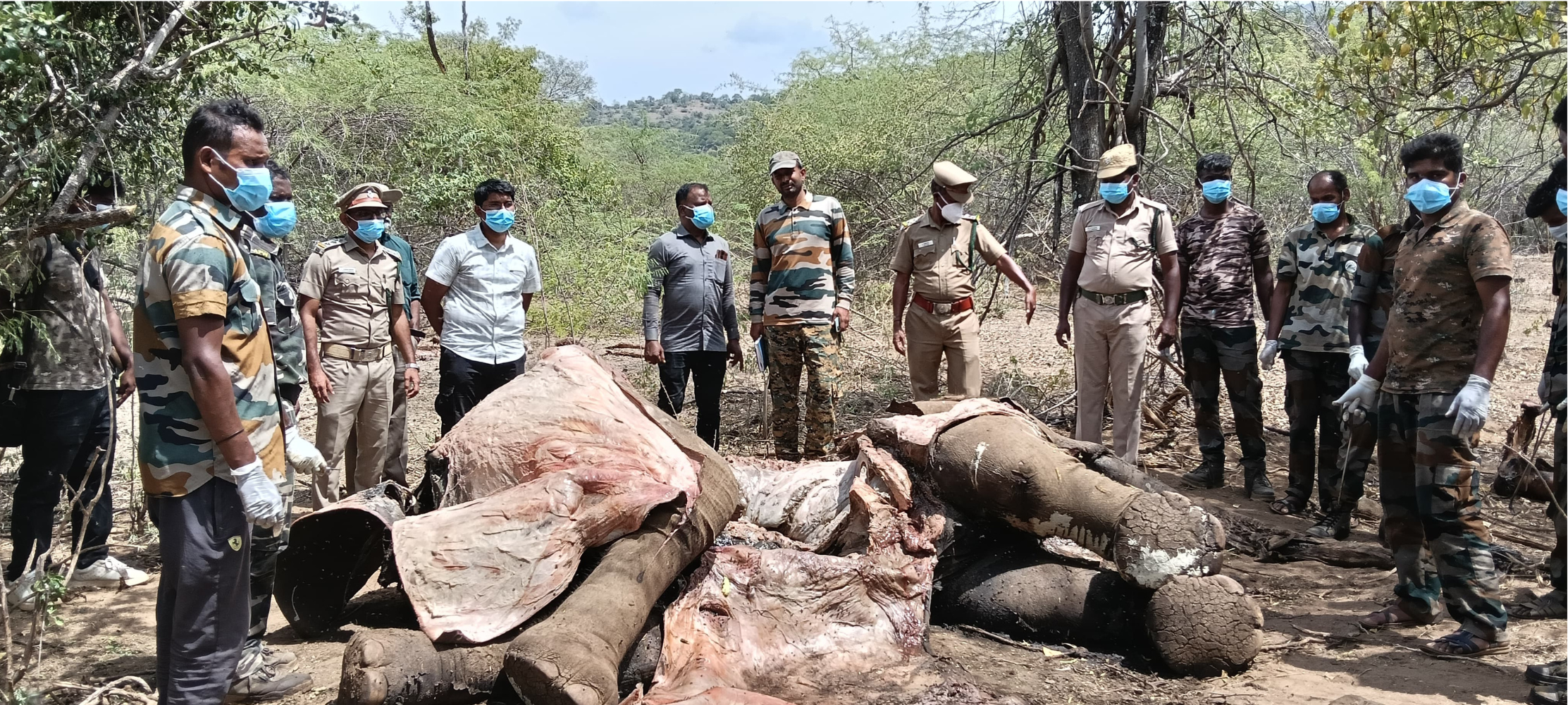
We traveled through the forest roads, guided by frontline forest staff who were waiting for us. When we arrived, the elephant lay on the ground, slumped like a giant rock. The forest department staff estimated its age to be around 50. This reminded me of a similar post-mortem I had attended in the same forest area 13 years ago.
Even before the examination began, we saw vulture droppings on the elephant's body, a clear sign that they had already located the carcass. However, the thick hide was too tough for them to tear open. Instead, they had settled for the softer tissues of the eyes, which they had gouged out.
The Red-headed Vulture's sharp, hooked beak gives it a distinct advantage. They are often the first to arrive at a carcass, using their powerful beaks to tear open the tough skin. This action makes the carcass accessible for other vultures and scavengers. The beaks of other vulture species are better suited for gripping and pulling flesh rather than tearing through a thick hide.
The significant decline in the population of Red-headed Vultures is a cause for serious concern. Recently, five vultures died in the Bandipur Sanctuary, and two of them were Red-headed Vultures. This loss is a devastating blow to an already threatened species.
Thousands of flies swarmed the elephant's body, laying their eggs to continue their lifecycle.
Under the supervision of Mr. Vidyadaran, the Deputy Director of the Mudumalai Sanctuary, wildlife veterinarian Dr. Rajesh conducted the post-mortem with the help of frontline staff. The veterinarian noted that there were no signs of food in the elephant's stomach for the past five days. He concluded that the elephant likely died of old age and related health issues. It was also a notable that it was a tuskless male. Since there was no sign of infectious microorganisms like Anthrax, the carcass was left for other scavenging animals to feed on, including vultures. To make it more accessible, nearby thorn bushes were cleared away. The deceased elephant will feed at least 350 vultures, along with wild boars, hyenas, and countless flies and maggots. It was a positive outcome, and I hope this practice continues.
Thanks to the forest department and especially AIWC.
Bharathidasan S
Secretary, Arulagam